Retail media is often discussed as though it is exclusively available to corporate giants with hundreds of stores, dedicated technology divisions, and massive capital budgets. This assumption is stopping mid-sized, multi-site retailers, regional franchise owners, and independent buying groups from accessing one of the most profitable commercial opportunities in the market today.
The reality is far more accessible. You do not need an enterprise capital budget to launch a highly successful in-store digital network. By shifting your approach from an ownership model to an operational expenditure (OpEx) model, mid-sized retail operators can deploy high-impact digital signage networks across multiple locations without upfront capital risk.
Why Delayed Deployment Means Lost Revenue
The South African retail landscape is changing rapidly. While global retail media began as an online app phenomenon, local market dynamics are driving the real growth back into physical store environments.
In South Africa, the vast majority of fast-moving consumer goods (FMCG) purchases and daily essential shopping still happen in person. Shoppers make their final buying decisions right at the shelf edge. Every week your stores operate with traditional print posters or unmanaged, static screens is a week when your brand partners spend their trade marketing budgets elsewhere.
The footfall you have already invested time, marketing, and operational budget to build is currently delivering zero media revenue. Meanwhile, competitors who launch retail media networks, even on a smaller, regional scale, are building deeper relationships with FMCG brands. They are securing recurring, high-margin revenue streams that grow over time. The question is no longer whether your business can afford to build an in-store media network. The question is whether you can afford to let that revenue go to other networks.
Shifting From Technology Ownership to AV as a Service
An OpEx retail media model means that your entire digital infrastructure is delivered as a managed service rather than a capital purchase. This approach is widely known as Audio-Visual as a Service (AVaaS).
Rather than committing to a hefty initial investment, which demands intricate board approvals, capital allocation committees, and prolonged corporate procurement processes, you gain access to a broad technology stack for a consistent monthly fee. This stack includes:
Commercial-grade digital displays and high-brightness window screens.
Network media players and specialised mounting hardware.
Cloud-based content management software (CMS).
Professional installation, data cabling, and rack planning.
Proactive remote monitoring and continuous technical support.
Under a managed service model, a specialised technology partner handles the complex technical details. They ensure network stability, manage media playback logs, and handle hardware maintenance. This leaves your internal operational and marketing teams completely free to focus on trading, cultivating brand relationships, and maximising advertising revenue.
Self-Funding Networks Through Smart Commercial Partnerships
For retailers with established brand partnerships and high supplier engagement, a revenue-share model offers an even lower barrier to entry. In this setup, the technology provider funds the entire deployment, hardware procurement, and physical installation of the infrastructure in exchange for a percentage of the advertising revenue the network generates.
This model makes the retail media network completely self-funding. The physical screens begin earning for your business from day one, and the infrastructure is paid for directly by the commercial activity it creates. For mid-sized retail groups with strong trade relationships but tight capital constraints, this removes the financial risk entirely, turning a potential cost centre into an immediate profit generator.
Accelerating Rollouts by Eliminating Corporate Red Tape
One of the most overlooked benefits of choosing an OpEx managed service is speed to market. Enterprise capital expenditure (CapEx) projects are notoriously slow. They involve lengthy budget sign-offs, internal engineering reviews, and extended procurement lead times that can stall a project for months or even years.
An OpEx model bypasses the majority of this corporate red tape. Because it is treated as an operational cost rather than a major capital investment, decision-making is streamlined. If you operate 10, 20, or 50 stores and want an active retail media proposition live before the end of the year, the managed service route is the most practical way to achieve it.
Structuring the In-Store Journey for Maximum Return
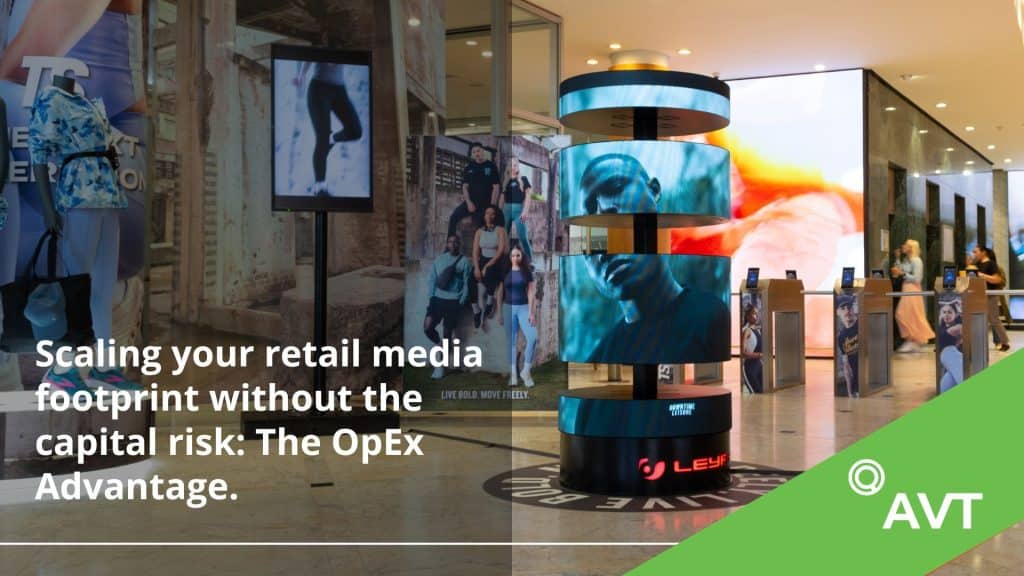
A successful retail media network requires more than just hanging standard television screens on a wall and running a random video loop. To command premium advertising rates from FMCG brands, the network must be strategically mapped to the shopper journey within the store layout. A structured rollout typically focuses on distinct zones:
Storefront and Windows: Utilising large video walls and high-brightness screens to grab the attention of foot traffic in busy mall walkways or outdoor parking zones, drawing shoppers inside.
The Entrance Zone: Positioning digital kiosks and promotional displays to shape the shopper’s initial choices and direct them toward featured in-store campaigns.
Aisles and End-Caps: Implementing digital promo boards and shelf-edge displays where the final product choice happens, directly influencing brand switching at the point of purchase.
The Checkout Zone: Using integrated till screens and queue management displays to capitalise on shopper dwell time, presenting last-minute offers right before the loyalty card swipe.
By treating the store as a multi-zone media asset, you can offer brand partners targeted slots based on location, time of day, or specific product categories.
Core Operational Elements Required for Launch
To launch a successful network under an OpEx model, your business does not need tech expertise, but it does need to provide three core components:
Existing Brand Relationships: Partners and suppliers who already sell products on your shelves and want direct, measurable access to your shoppers.
Strategic Physical Locations: Well-positioned areas within your store layouts that naturally attract high foot traffic and offer clear visibility for digital displays.
Internal Commercial Focus: A dedicated team member or manager who can drive the advertising proposition internally, coordinate with suppliers, and manage brand partner conversations.
The technology partner provides the rest, from brackets and cabling to the cloud-based CMS used to schedule and report on the campaigns.
How AVT Delivers the Turnkey Solution
Building a resilient, high-performance retail media network requires a system integrator who understands how to merge hardware, software, and live retail environments. AVT provides complete, turnkey audio visual solutions designed to help South African retailers scale their digital footprint without the technical headache.
With over 20 years of experience as a trusted technology partner, AVT handles the entire lifecycle of your retail media infrastructure. We take care of everything from system design and hardware deployment to secure installation and cloud content management. Our proactive monitoring and on-site field support across South Africa minimise screen downtime, ensuring your advertising loops run smoothly and reliably.
By moving away from traditional hardware purchases to embracing a contemporary managed service, you can turn your physical store network into a high-performing channel, all while keeping your capital available for essential business expansion.
Frequently Asked Questions
What exactly is the OpEx model in retail media?
The OpEx model is an operational payment structure where a multi-site retailer accesses a complete digital signage and content management infrastructure as a monthly managed service, rather than buying the hardware outright. Instead of drawing from a limited capital budget (CapEx) to purchase screens, media players, and mounting brackets, the entire audio-visual system is treated as an ongoing operational cost. This lowers the barrier to entry, protects cash flow, and transfers the technical responsibility of network uptime to a specialised system integrator.
What technologies can be implemented using the OpEx model?
Retailers can implement a multi-zone media footprint without upfront capital. This includes high-brightness window displays to capture mall foot traffic, interactive digital kiosks for the entrance zone, commercial-grade promo boards for aisle end-caps, and integrated point-of-sale displays at checkout queues. The model also covers the back-end technology that makes the network valuable to brands, such as edge-based media players that keep content looping offline and cloud-based content management software (CMS) for centralised campaign scheduling.
What challenges do retailers face when expanding their media footprint?
The primary challenge is ensuring technical alignment across varying store layouts and localised network limitations. Maintaining system uptime across multiple regional branches can strain an internal IT department that isn’t equipped to handle live media playback. Additionally, retailers must ensure their content management platform is reliable enough to provide transparent playback logs to FMCG brand partners. Choosing a managed service framework solves this by placing the burden of remote monitoring, field maintenance, and campaign proof-of-performance reporting on the AV partner.
How can partnering with experts help in retail media expansion?
Partnering with experts like AVT can help in retail media expansion by providing access to customised solutions and ongoing support. As a brand-agnostic system integrator, AVT offers high-quality technologies and services tailored to the unique needs of each retailer, ensuring successful implementation and minimal disruption to operations. AVT’s expertise in standards-based audio visual installations and 24/7 technical support ensures retailers receive reliable and effective media solutions. This collaborative approach allows retailers to focus on their core business activities while benefiting from the latest advancements in retail media.