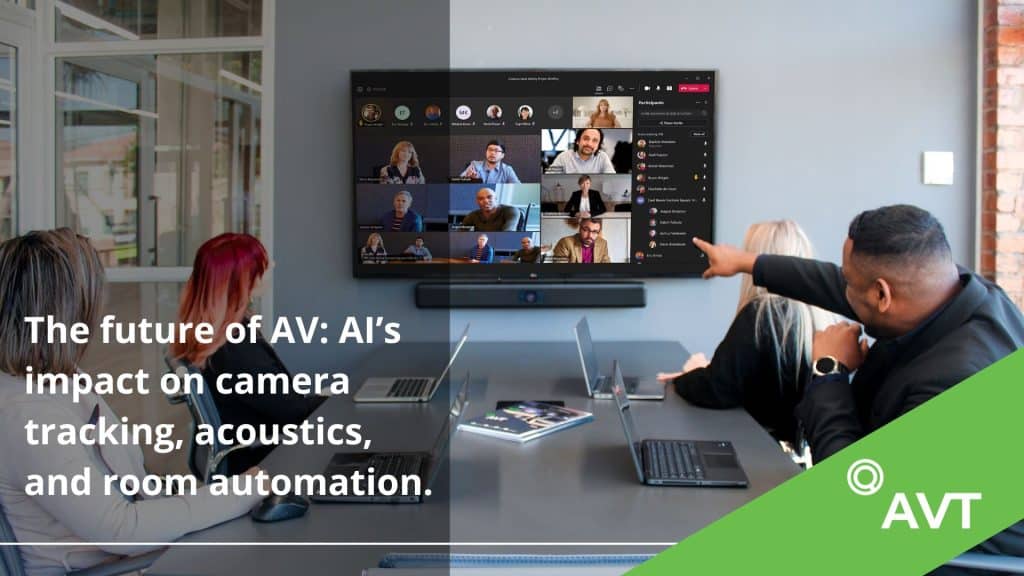
Artificial Intelligence (AI) is revolutionising the audio-visual (AV) industry, particularly in the areas of camera tracking, acoustics, and room automation. As businesses seek more efficient and engaging communication solutions, AI technologies are stepping up to meet these demands by enhancing video conferencing experiences, optimising acoustic environments, and automating room setups.
AI in Video Conferencing
Real-Time Image Enhancement
AI technology integrated into video conferencing cameras allows for real-time correction of digital pixelation, ensuring that participants on the far side receive a clear and perfect image. This advancement is crucial as it enables the use of digital cameras over optical ones, providing flexibility and cost-effectiveness without compromising quality.
The ability to correct pixelation in real-time is a game-changer for businesses that rely heavily on video conferencing. It ensures that meetings are not disrupted by poor image quality, maintaining professionalism and enhancing communication.
AI-driven cameras can set dedicated video zones, eliminating unwanted views and focusing on key participants. This feature enhances engagement during calls, creating a more focused and distraction-free environment.
AI Camera Tracking
Traditional camera tracking relied on manual configurations and audio cues from microphones. However, AI advancements have automated this process, allowing cameras to track participants based on eye contact and movement. This not only simplifies the setup but also enhances the natural flow of conversations during video calls.
By automating camera tracking, businesses can save time and resources that would otherwise be spent on manual configurations. This ensures the camera follows the conversation naturally, maintaining a professional and engaging meeting environment.
AI camera tracking is particularly beneficial in large conference rooms where multiple participants are present. It ensures the camera focuses on the active speaker, providing a seamless experience for all participants.
Automation in AV Systems
Self-Deploying Solutions
AI-driven automation features are transforming the installation and operation of AV equipment. Self-deploying solutions simplify the setup process, allowing businesses to quickly and efficiently implement AV systems without the need for extensive technical expertise.
This automation reduces the time and cost associated with traditional AV system installations, making it accessible to a broader range of businesses. It also ensures that the systems are optimised for performance, as AI continuously analyses and adjusts settings based on room conditions.
By automating these processes, businesses can focus on their core operations, knowing that their AV systems are running smoothly and efficiently.
Room Automation
AI technology is capable of analysing room conditions such as acoustics and participant distances, automatically adjusting settings to achieve optimal results. This level of automation was previously unattainable, requiring manual adjustments by skilled technicians.
With AI, room automation becomes a seamless process, ensuring that every meeting is conducted in an environment that is acoustically optimised and visually engaging. This enhances the meeting experience and improves overall communication effectiveness.
Businesses can benefit from this technology by providing their teams with a professional and efficient meeting environment, ultimately leading to better collaboration and decision-making.
The Broader Impact of AI in AV Systems
AI’s influence on AV systems is not limited to the basic functionalities of video conferencing and room automation. It extends to creating more dynamic and adaptive environments across a variety of spaces, including corporate offices, retail environments, and hospitality venues.
Intelligent Control Systems
AI is revolutionising AV integration by automatically adjusting not just audio and video, but also lighting and environmental controls in real time. This intelligent control system adapts based on environmental conditions or user preferences, ensuring the space is always optimised for the task at hand. This level of integration is particularly beneficial for businesses that require high-quality, tailored experiences without the need for constant manual adjustments.
Predictive Maintenance
Another critical application of AI in AV systems is predictive maintenance. AI monitors the health of AV equipment and provides early warnings of potential issues before they disrupt operations. This proactive approach reduces downtime, ensures system longevity, and lowers maintenance costs, making it an invaluable addition to any AV setup.
Enhancing Commercial Environments
AI is also helping transform the way businesses utilise AV systems in commercial spaces. Whether in a conference room, retail environment, or hotel lobby, AI-powered AV solutions provide real-time dynamic adjustments that create a more responsive and engaging user experience. These smart environments improve the overall quality of service and customer engagement, making AI-driven AV systems increasingly essential for modern businesses.
Acoustic Analysis with AI
Noise Cancellation Technology
AI-powered noise cancellation technology is revolutionising the way audio is managed in meeting rooms. By analysing and excluding unwanted areas within a room, AI ensures that only the desired audio is transmitted to far-end participants, resulting in a cleaner and more professional sound experience.
This technology, known as audio fencing, is similar to video fencing and is entirely driven by AI. It enhances the quality of communication by eliminating background noise and focusing on the speaker’s voice.
For businesses, this means that meetings can be conducted without the distractions of ambient noise, leading to more productive and focused discussions.
Acoustic Optimisation
AI’s ability to analyse and optimise room acoustics is a significant advancement in the AV industry. By continuously monitoring and adjusting acoustic parameters, AI ensures that the audio quality is always at its best, regardless of the room’s size or shape.
This optimisation is particularly beneficial in large or irregularly shaped rooms where traditional acoustic treatments may not be effective. AI provides a dynamic solution that adapts to the room’s conditions in real-time.
Businesses can leverage this technology to ensure that their meeting rooms provide the best possible audio experience, enhancing communication and collaboration among team members.
AI-Driven Accessibility Features
Voice-to-Text Transcriptions
AI’s ability to convert voice to text in real-time is a powerful tool for accessibility. This feature is particularly beneficial for individuals with hearing impairments, as it allows them to follow along with meetings and discussions through transcriptions.
By providing voice-to-text transcriptions, businesses can ensure that their meetings are inclusive and accessible to all participants, regardless of their abilities. This not only enhances the meeting experience for individuals with disabilities but also demonstrates a commitment to inclusivity and diversity.
In addition to accessibility, voice-to-text transcriptions can also be used for record-keeping and documentation purposes, providing a valuable resource for businesses.
Cultural Translation in AV Systems
AI-driven translation services are becoming increasingly advanced, bridging the gap between different regions and cultures. This technology allows for real-time translation of spoken language, enabling seamless communication between participants who speak different languages.
For businesses operating in a global market, this feature is invaluable as it facilitates communication and collaboration across borders. It ensures that language barriers do not hinder the flow of information and ideas.
By incorporating AI-driven translation services into their AV systems, businesses can expand their reach and engage with a diverse range of clients and partners.
AI-Powered Equipment in AV
Smart Video Zones
AI-powered equipment, such as smart video zones, allows for enhanced control over what is displayed during video conferences. By setting dedicated zones, businesses can eliminate unwanted views and focus on key participants, enhancing engagement and maintaining a professional environment.
This feature is particularly useful in large meetings where multiple participants are present, as it ensures that the focus remains on the active speaker or presentation.
By utilising smart video zones, businesses can create a more engaging and focused meeting experience, ultimately leading to better communication and collaboration.
AI in AV Analytics
AI is enhancing AV analytics by providing detailed and evolving reports that offer valuable insights into system performance and usage. This data-driven approach allows businesses to make informed decisions about their AV systems, optimising them for performance and efficiency.
By leveraging AI analytics, businesses can identify trends and patterns in their AV usage, allowing them to make strategic decisions about future investments and improvements.
This level of insight is invaluable for businesses looking to maximise the return on their AV investments and ensure that their systems are meeting their needs.
Conclusion
As the AV industry continues to evolve with the rapid advancements in AI, AVT remains at the forefront of these developments, ensuring that our clients benefit from the latest innovations in camera tracking, acoustics, and room automation. By embracing AI-driven solutions, we are not only enhancing the quality of communication and collaboration but also making AV systems smarter, more efficient, and accessible. At AVT, we are committed to staying ahead of the curve, providing cutting-edge technology that transforms the way businesses engage and interact in today’s dynamic environment.
Frequently Asked Questions
How does AI improve video conferencing?
AI enhances video conferencing by providing real-time image correction, automated camera tracking, and smart video zones. These features ensure that participants receive clear and focused visuals, enhancing engagement and communication. AI also automates many processes that were previously manual, such as adjusting camera angles based on eye contact and optimising audio settings for the best sound quality.
What are the benefits of AI-driven room automation?
AI-driven room automation simplifies the setup and operation of AV systems by automatically adjusting settings based on room conditions. This ensures optimal audio and visual quality without the need for manual intervention. Businesses benefit from reduced setup times, cost savings, and improved meeting experiences, as AI continuously optimises the environment for communication.
How does AI enhance acoustic analysis?
AI enhances acoustic analysis by continuously monitoring and adjusting audio settings to optimise sound quality. This includes noise cancellation and audio fencing, which exclude unwanted sounds and focus on the speaker’s voice. AI-driven acoustic optimisation ensures that meetings are conducted in an environment with the best possible audio quality, enhancing communication and reducing distractions.
What accessibility features does AI offer in AV systems?
AI offers several accessibility features, including voice-to-text transcriptions and real-time translation services. These features ensure that meetings are inclusive and accessible to individuals with disabilities or language barriers. By providing transcriptions and translations, AI facilitates communication and collaboration, demonstrating a commitment to inclusivity and diversity.
How can businesses leverage AI analytics in AV systems?
Businesses can leverage AI analytics to gain insights into their AV system’s performance and usage. AI provides detailed reports that help identify trends and patterns, allowing businesses to make informed decisions about system improvements and investments. By utilising AI analytics, businesses can optimise their AV systems for efficiency and effectiveness, maximising their return on investment.